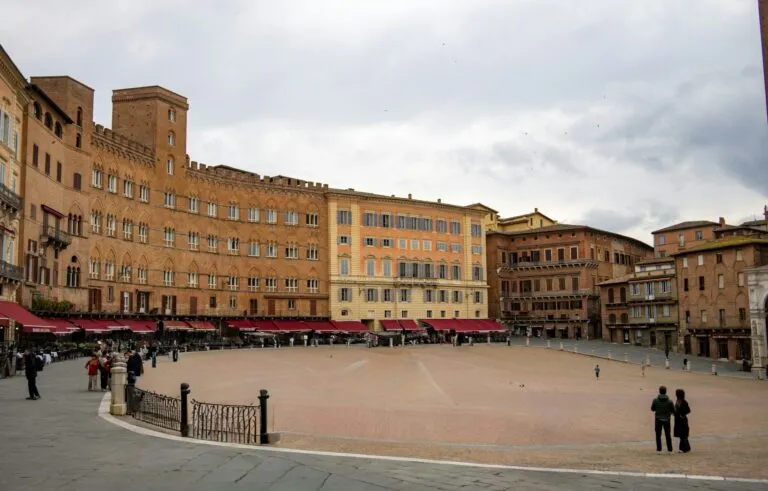
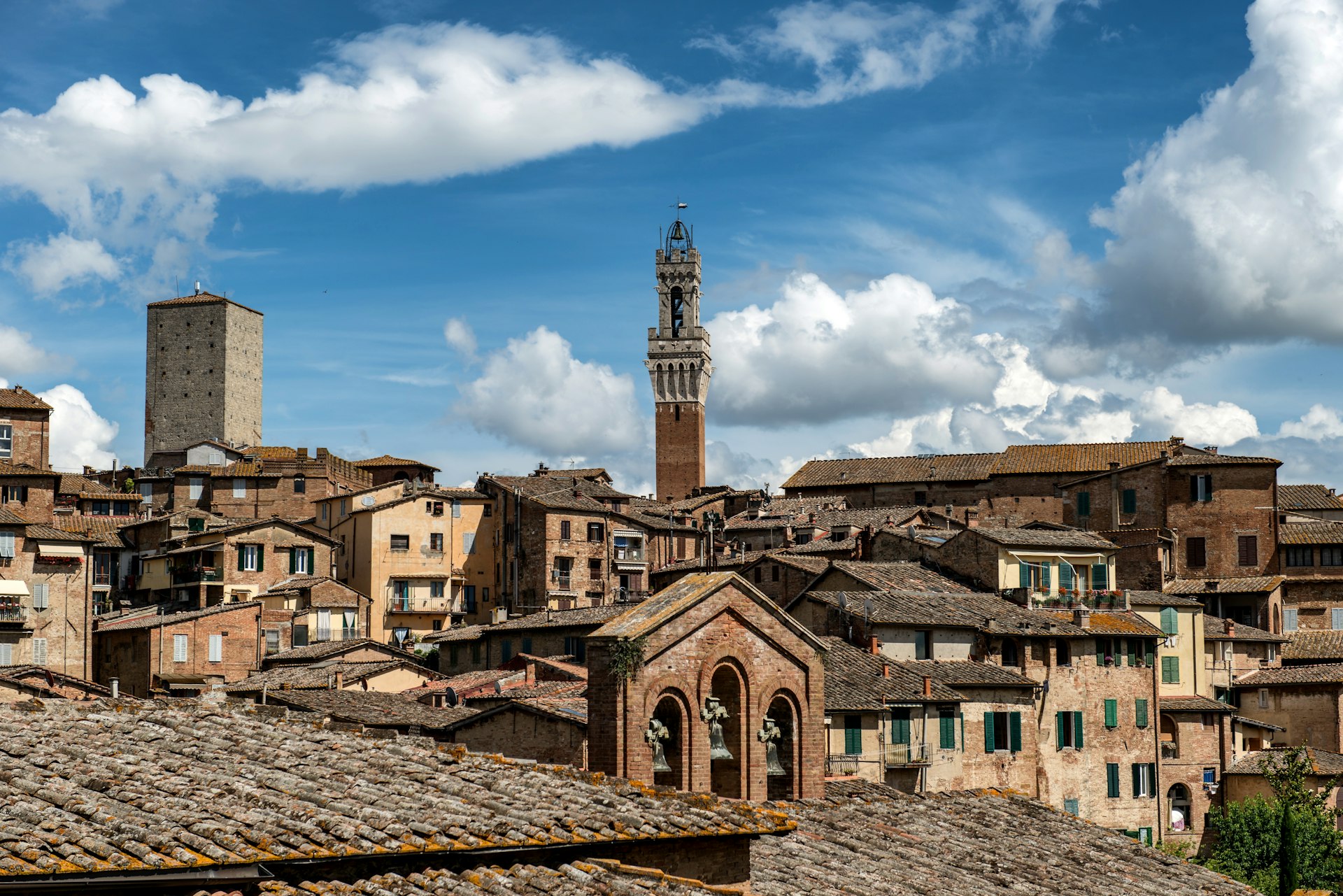
The contrade are Siena’s seventeen historic city districts, born in the Middle Ages as neighbourhood militia companies. Today they race twice a year in the Palio, on 2 July and 16 August, in Piazza del Campo (the shell-shaped square where the race is run), but they stay active communities all year round: each contrada has its own church, museum, baptismal fountain and coat of arms, which you can spot on walls across the centre. Understanding them changes how you read the city, even outside race days.
What are the contrade of Siena?
The contrade began in the Middle Ages as subdivisions of the city, originally tied to organising local militias. Over time they lost their military and administrative roles, but they kept a very strong identity: each contrada has a defined boundary, a patron saint, a motto, an allied contrada and a rival one. Membership usually comes from being born, or baptised, within a contrada’s territory. Buying a house there, marrying into it or moving in does not make you a member.
How many contrade are there, and what are their names?
The current number and boundaries date back to an edict issued by the governor Violante of Bavaria, between 1729 and 1730, which set the division still in use today. The seventeen contrade are:
- Aquila (Eagle)
- Bruco (Caterpillar)
- Chiocciola (Snail)
- Civetta (Little Owl)
- Drago (Dragon)
- Giraffa (Giraffe)
- Istrice (Porcupine)
- Leocorno (Unicorn)
- Lupa (She-wolf)
- Nicchio (Shell)
- Oca (Goose)
- Onda (Wave)
- Pantera (Panther)
- Selva (Forest)
- Tartuca (Tortoise)
- Torre (Tower)
- Valdimontone (Ram)
Three further contrade, Orso, Vipera and Spadaforte, were suppressed centuries ago. They now appear only in the historical parade that precedes each Palio, in their own costumes and under their own coats of arms.
What are the terzi, and how are the contrade grouped?
Before the contrade existed, Siena was already divided into three terzi (thirds): Terzo di Città, Terzo di Camollia and Terzo di San Martino, set up as administrative, civic and military divisions of the city. The seventeen contrade are spread across the three terzi, with six contrade in Terzo di Città, six in Terzo di Camollia and five in Terzo di San Martino.
| Terzo | Historic area | What to see |
|---|---|---|
| Terzo di Città | South-west, the oldest core of the city | The cathedral, the Santa Maria della Scala complex |
| Terzo di Camollia | North, towards the fortress | The main shopping street, the Fortezza Medicea |
| Terzo di San Martino | South-east | Piazza del Campo, Palazzo Pubblico |
How do you spot a contrada while walking around Siena?
The easiest clue is the small contrada fountains, built after the Second World War and decorated with each contrada’s symbol: this is where new members are baptised. At the corners where one contrada’s territory meets another, you will also find coats of arms and plaques on the walls, and in the weeks before the Palio the streets fill with flags in each contrada’s colours, hung from windows and strung between buildings.
Want a base for exploring the historic centre without worrying about check-out? The private, free car park inside the property lets you leave the car and walk into Siena, about 15 minutes from the Campo.
Why does each contrada have an animal or object as its symbol?
Every contrada carries an animal, a plant or an object in its name and coat of arms, dating back to the Middle Ages: the eagle, the caterpillar, the little owl, the snail, the wave, the tower. These symbols are not kept behind museum walls. You will find them carved on facades, arches and doorways across the old town: the eagle, for instance, appears on the arches and doors of Palazzo Marescotti, in the territory of the Aquila contrada. Spotting them as you walk is a simple way to tell which contrada you are in, without needing a guide.
Can you visit the contrada museums?
Every contrada has its own museum, usually inside its own clubhouse, holding the painted silk banners (drappelloni) won over the centuries, the costumes worn in the historical parade and other objects from its history. Many can only be visited by request or appointment, often for free or for a small donation: it is worth checking current access at Siena’s tourist office or directly with the contrada’s clubhouse, since opening times and availability vary from one museum to the next. Even without stepping into a museum, the contrada church is often the easiest place to visit: it is where the year’s most heartfelt moments take place, from the baptism of new members to the blessing of the horse before the Palio.
When is the best time to discover the contrade outside the Palio?
The weeks before the two races, in June and between July and August, are the liveliest: trial races in the days beforehand, dinners set up in the streets and flags everywhere. But the contrade are part of daily life in the quieter months too, when the centre is less crowded and you have more time to notice a symbol carved into a wall or a contrada’s name cut into a street corner. A stay in autumn or winter, with the villa’s park waiting for you at the end of the day, leaves room for exactly this kind of slow walk: no race to follow, just time to stop in front of a small fountain or step into a contrada church while it is open.
The practical advantage is a simple one: you can leave the villa in the morning, spend the day among the districts of the old town and come back in the evening to a 9,500 square metre park, away from the traffic and noise of the narrow streets.
For directions and distances, see the how to reach us page. The story of the villa that will host you before you set off into Siena’s districts is told on the our story page, and the rooms where you can rest after a day on foot are described under rooms and suites.
Already thinking about when to come back to Siena? Booking directly on the website gets you the best rate guaranteed, a 10% discount and breakfast included.
Frequently asked questions
How many contrade are there in Siena?
There are seventeen, plus three suppressed centuries ago, Orso, Vipera and Spadaforte, which now appear only in the historical parade before the Palio.
How do you become a member of a contrada?
Usually by being born, or baptised, within its territory. Buying a house there, marrying into it or moving in does not make you a member.
What is the difference between a contrada and a terzo?
The terzi are the city's three historic thirds, Terzo di Città, Terzo di Camollia and Terzo di San Martino, across which the seventeen contrade are spread.
Can you visit the contrada museums without booking?
Many can only be visited by request or appointment: it is worth checking in advance with Siena's tourist office or directly with the contrada's clubhouse.